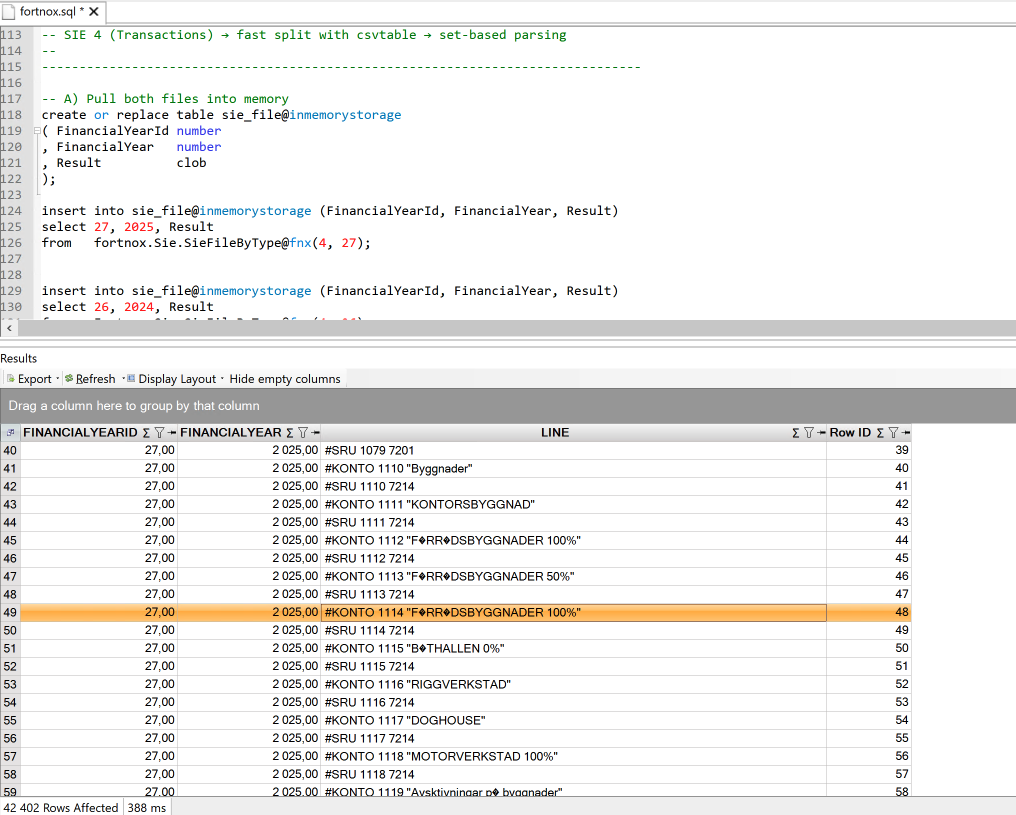
create or replace table sie_file@inmemorystorage
( FinancialYearId number
, FinancialYear   number
, Result          clob
);
insert into sie_file@inmemorystorage
( FinancialYearId
, FinancialYear
, Result
)
select 27
,      2025
,      Result
from   fortnox.Sie.SieFileByType@fnx(4, 27)
insert into sie_file@inmemorystorage
( FinancialYearId
, FinancialYear
, Result
)
select 26
,      2024
,      Result
from   Fortnox.Sie.SieFileByType@fnx(4, 26)
create or replace table sie_lines@inmemorystorage
as
select f.FinancialYearId
,      f.FinancialYear
,      t.line
from   sie_file@inmemorystorage f
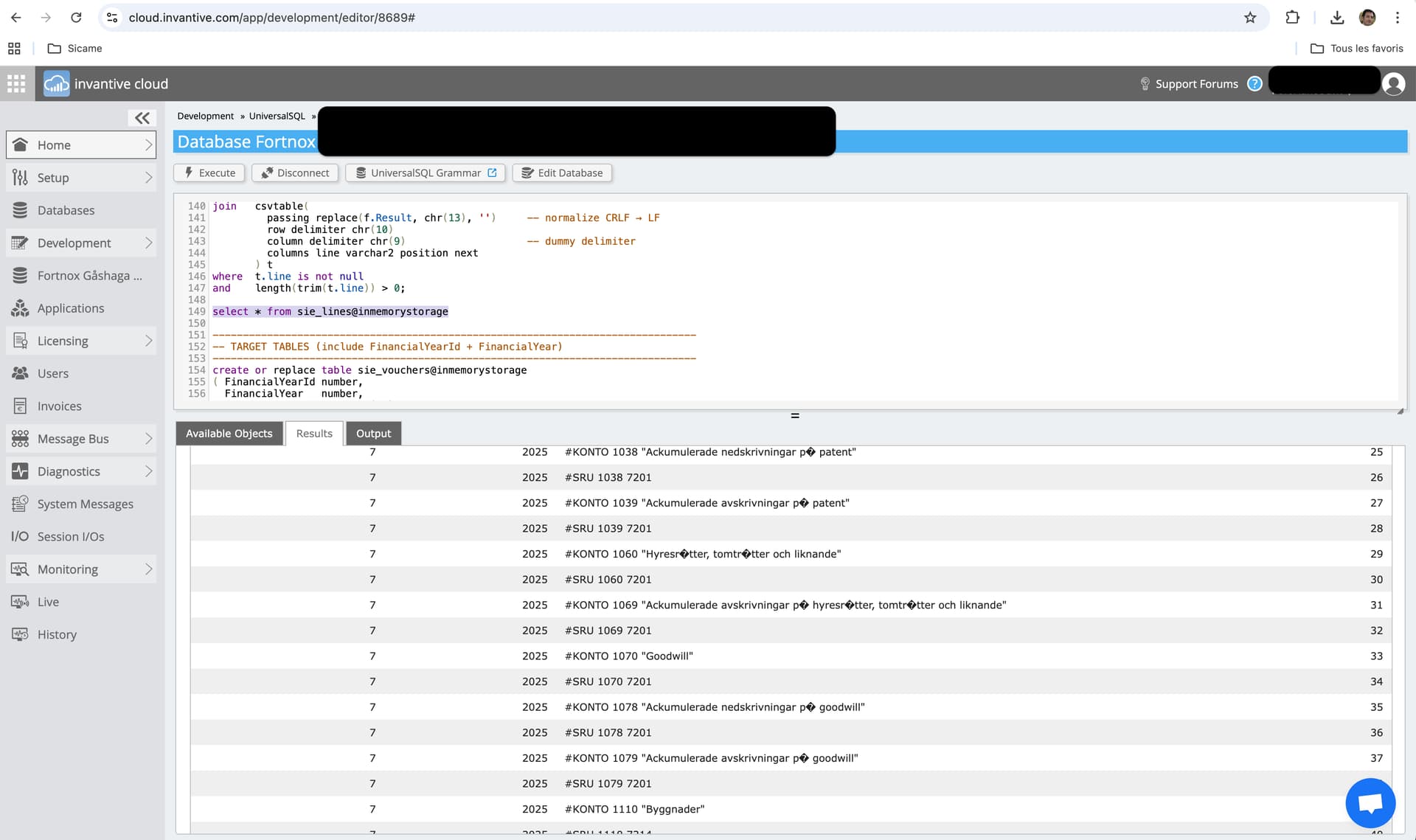
join   csvtable
       ( passing replace(f.Result, chr(13), '')     -- normalize CRLF → LF
         row delimiter chr(10)
         column delimiter chr(9)                    -- dummy delimiter
         columns line varchar2 position next
       ) t
where  t.line is not null
and    length(trim(t.line)) > 0
The use of SIE (with associated issue described) is currently not planned for the short time period. Current focus is on year end work and digital sovereignty. SIE is identified as an important element to improve performance of the Fortnox driver, but has less priority. A short analysis will be done next week to see whether there is any quick option.
Starting release 25.0.160, the missing character set conversion from code page 437 of the SIE (Swedish audit file) format as returned from Fortnox to Unicode will be included.
This ensures that all special characters such as a-umlaut are shown correctly.
This question was automatically closed after at least 1 week of inactivity after a possible solution was provided. The last answer given has been marked as a solution.
Please ask a new question via a separate topic if the problem occurs again. Please include a link to this topic in the new question by pasting its URL into the text.